The challenges of running an Allied Health practice
Running an allied health or wellness practice is a labour of love. You’re passionate about helping your clients achieve better health outcomes, whether through Physiotherapy, Psychology, Osteopathy, Chiropractic care, and so on. But with so much focus on client care, the business side of things—especially marketing—often takes a backseat.
Many practice owners find themselves wearing too many hats. One minute you’re treating a client, the next you’re answering emails, and then trying to squeeze in time to post on social media or update your website. Marketing for allied health practices isn’t straight forward, an omni-channel approach is necessary. Marketing isn’t just an add-on; it’s a crucial part of growing and sustaining your practice. And this is where professional marketing support can make all the difference.
The reality of DIY marketing: Is it holding you back?
Marketing isn’t as simple as posting the occasional update on Instagram. Marketing for Allied health practices in Australia requires a tailored approach. The market competition is the highest its ever been, with Allied Health Professionals having the highest comparative industry growth in the health sector, of 67%. (AIHW Australia’s health 2024)
Allied Health marketing is not like other marketing, you need to consider the unique offerings of your brand, your ideal audiences wants and needs, the marketing landscape, the healthcare sector, compliance and what makes your practice unique. Here are some common struggles faced by allied health and wellness practices trying to manage their own marketing:
Time Constraints – With client appointments, admin, recruitment and professional development, marketing often gets pushed to the bottom of the to-do list.
Lack of Strategy – Posting randomly on social media or running a Google ad without a clear strategy can lead to wasted effort and money.
AHPRA Compliance – The Australian Health Practitioner Regulation Agency (AHPRA) has strict guidelines around advertising health services. Many practitioners unknowingly breach these rules, leading to potential fines.
Inconsistent Branding – Without a clear brand message and visual identity, your practice can struggle to stand out and attract the right clients.
SEO Confusion – Search engine optimisation (SEO) is crucial for helping potential clients find your services online, but it requires expertise to get it right.
Keeping up with the ever evolving landscape – AI and Automation is starting to be used not only in marketing but diagnosis and treatment too..
How professional marketing support can help
78% of Australian adults use the internet to find health-related information.Investing in marketing support tailored to allied health and wellness businesses can:
Increase visibility – More people searching for your services will find you.
Build trust and authority – Consistent, high-quality content and branding helps establish credibility and trust.
Relationship building and referral partnerships – Helping build trust in vital integrated care model relationships. This creates a steady flow of referrals in and out of the practice. Building solid relationships with a multi-disciplinary team is an essential component of allied health marketing. When allied health professionals work side-by-side with GPs and other allied health or specialist providers, there is a seamless flow of information and expertise that benefits the patient.
Save you time and energy – Focus on client care while experts handle the marketing.
Ensure AHPRA compliance – Avoid advertising pitfalls, potential huge fines and maintain ethical standards.
How Versatile Marketing helps Allied Health and Wellness practices with professional marketing support
1. Strategy, planning and training
Running inhouse and online workshops and training sessions to teach DIY
Creating a SMART marketing strategy, which will be incorporated into your practice processes and your outsourcing methods. This will look at things like: tone of voice, online communication methods, the holistic marketing approach e.g. referral partner strategy, networking and partnerships, website maintenance, blogging, statistical analysis and review meetings, competition, unique value propositions, frequency, ideal audience analysis, and how you will exhibit effective communication of your brand through consistent clear, empathetic plain English, and compliance with AHPRA guidelines.
Quarterly content planning sessions
2. SEO and website optimisation
Your website is your digital front door. If it’s not optimised for SEO, potential clients won’t find you. An SEO-optimised website:
Uses the right keywords (e.g., “physiotherapist Sydney” or “psychologist for anxiety Brisbane”). Ensure images are well labelled and sized, ensure your website is technically optimised to rank higher in search engine results.
Loads quickly and is mobile-friendly and user-friendly.
Has clear and non-guilt driven calls-to-action (CTAs) like “Book an Appointment.” and not “don’t miss out”, Followed by an easy to use booking system.
Content to be informative, including details like contact information, availability, your team, services, your WHY (about), and additional educational type content like FAQs, blogs, videos, infographics, downloadable resources, these are an essential ingredient to build rapport and trust. Topics might cover common health concerns, modalities that your team are trained in, the process to book a particular service, or the benefits of seeking support (using evidence-based findings).
Tip: A professional marketing team can audit your website and implement the necessary SEO strategies to boost traffic.
3. Social media management
Social media is a powerful tool for educating, engaging, and attracting clients. However, it requires consistency and strategy.
Content should educate, inspire, and build trust.
Platforms like Instagram, Facebook, and LinkedIn work best for different types of content.
Engagement matters—responding to comments and messages builds relationships.
Tip: A social media manager ensures your posts are on-brand, consistently posted, compliant, and reaching the right audience, focusing on the platform they most visit.
4. Content marketing: Blogging, emails & more
Regular content—whether in the form of blogs, emails, or videos—helps establish you as a trusted expert.
Blogging improves SEO and answers common client questions.
Email marketing keeps current and potential clients engaged and referral partners informed.
Tip: A marketing team can plan, write, and distribute your content to maximise engagement.
5. Google Business Profile optimisation
Google Business Profile (GBP) is essential for local search visibility. An optimised profile:
Appears in Google Maps when people search for services nearby.
Displays key business info like hours, contact details, and services.
Collects and showcases client reviews (which improve credibility).
Tip: If you’re not ranking in local searches, your GBP likely needs work.
6. Paid advertising (Google & social media ads)
This service is coming soon.
While organic marketing is crucial, paid advertising helps accelerate growth. Allied health businesses can benefit from:
Google Ads targeting people searching for specific services.
Facebook, Instagram or LinkedIn ads designed to attract the right audience.
Retargeting ads to reach people who’ve previously visited your website.
Tip: A marketing expert can help set up and manage ads for the best return on investment.
The power of outsourcing: Work smarter, not harder
As an Allied health business owner, your expertise is in patient care—not in marketing algorithms, SEO, or content strategies. By outsourcing your marketing to professionals who understand both the industry and the latest trends, your free up time to focus on your clients while ensuring steady business growth, by boosting client satisfaction.
At Versatile Marketing, we specialise in helping Allied Health and Wellness businesses gain visibility, attract their ideal clients, and stay compliant with AHPRA regulations. Whether you need a complete marketing overhaul or just some strategic support, we’re here to help.
Ready to grow your practice without the marketing headache?
At Versatile Marketing, we provide professional outsourced marketing support for small businesses just like yours. If you’d like to find out more, visit our website or book in a complimentary discovery call. Don’t forget to download your FREE copy of our seasonal, printable content planning calendar. Just sign-up in the form at the bottom of this page.
Why Google Business Profile is a smart move for health and wellness businesses
In today’s digital age, a strong online presence is essential. For Allied Health and Wellness practices in Australia, standing out in a crowded local market can be challenging. This is where Google Business Profile (GBP) comes in. Properly optimised, GBP can boost your local visibility and attract local ideal customers, making it easier for potential clients to find your practice when they need it most.
This blog is relevant to all Allied Health practices: whether you’re a physiotherapist in Perth, an Osteopath in Sydney, a Kinesiologist in Canberra, or a Dentist in Cairns, GBP is a smart marketing move.
When potential clients search for health services like yours, Google Business Profile increases your chances of appearing in local search results. Optimising your GBP with accurate service details, reviews, offers and photos positions you as a trusted and accessible provider in your area. This leads to higher visibility and engagement with the right clients at the right time.
How does my ideal client find my clinic?
Consider how your ideal clients typically find out about your practice.
The four common marketing avenues are:
Digital Search – This includes Google, social media, directories, and email marketing.
Referrals – A vital strategy, but we’ll discuss this more in a future blog.
Physical Signage & Print Media – Brochures and handouts still have value.
Public Speaking – Speaking engagements at schools, conferences, or networking events.
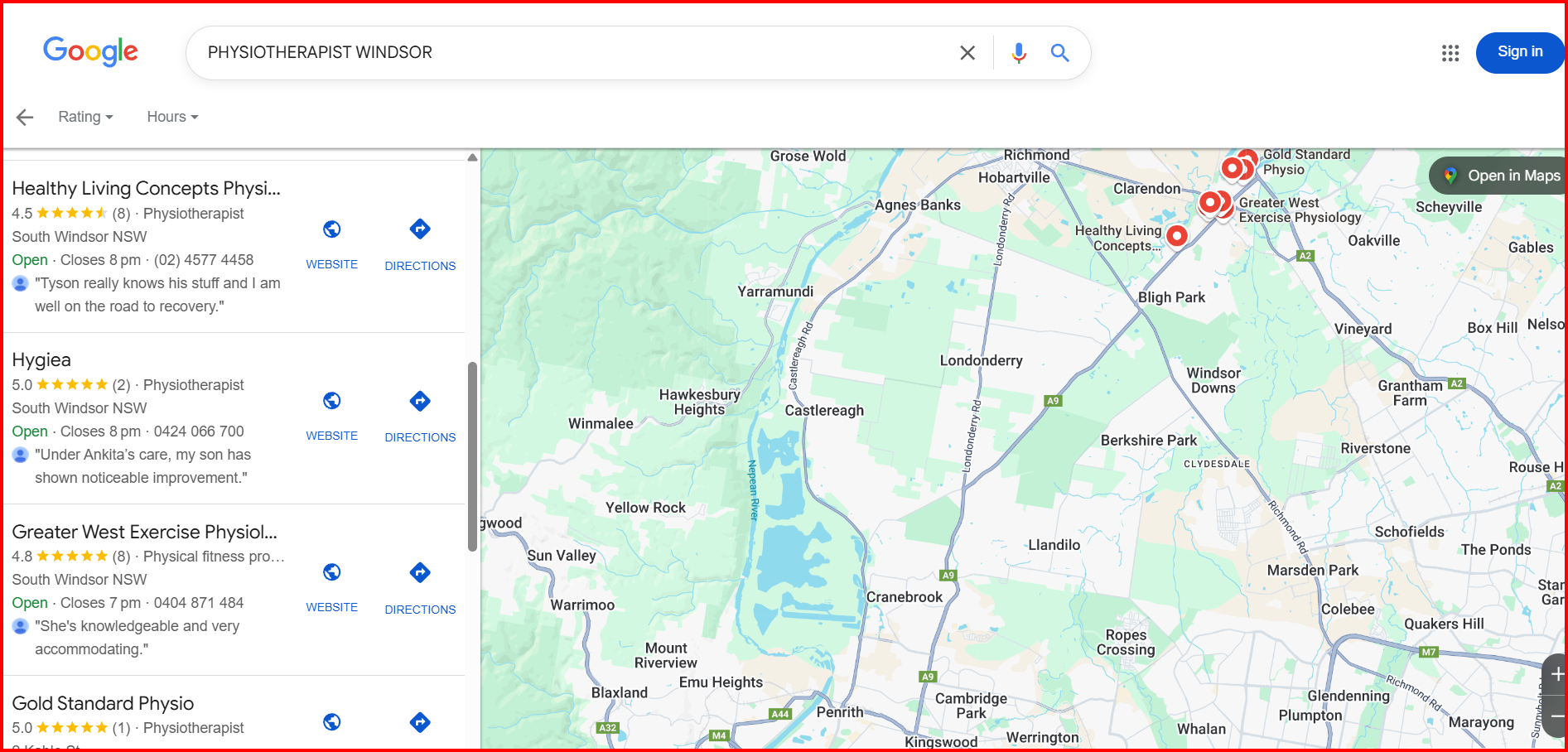
Today, we focus on one aspect of digital search, and perhaps one, if not the most prominent way local customers will find you and your practice! Google Search, and more specifically your Google Business Profile, plays a significant role in helping clients find your clinic through local search.
According to Stat Counter, as of July 2024 Google remains the leading search engine in terms of market share in Australia at 93.95%. Bing follows second at a measly 4.48%.
How to get found on Google
For local clients to find you, focus on these two key digital assets:
An AHPRA-compliant, search engine optimised (SEO) website.
An active, well-optimised Google Business Profile (Local SEO).
Of course, there are other factors for local and general optimisation, like social media, directories, podcasts and basically all other ways you’re connected online. Simply said, the more online presence you have, the easier it is for people to find you. Therefore, hopefully they will also begin to know, like and trust your brand.
Why is it so important to have a digital presence?
According to RedSeach, “Aussies spend 6.8 hours EVERY DAY searching the web”. They use it to shop, research, and look for which provider suits their health concern, and also to locate specific service providers in their local area to help with various physical and mental health concerns. So, if you don’t have a website or GBP… you’re missing a HUGE market of potential clients.
Still not convinced your Aussie Allied Health or wellness business needs a fully optimised GBP listing to attract local ideal customers? No worries…grab a cuppa, and read on, as I share why it’s fab for your practice.
Your Google Business Profile isn’t just a listing—it’s a gateway for Allied Health and wellness businesses to connect with local clients, build trust, and drive meaningful growth. In today’s digital world, visibility starts here. Deborah Ricketts
Why should your practice be on Google Business Profile?
Well, for starters, in this financial climate, we’re all looking for the best return for least investment, and GBP has you covered here – it’s free! And you will have a distinct advantage over more than half of the business population, as 55% of Australian local businesses haven’t claimed their GBP listing. I know right!?
1. Enhanced online visibility
Google Business Profile allows clients to find your practice based on location via Google Maps. It shows essential details like phone number, address, and reviews, making it easier for clients to connect with you.
2. Improved local SEO
Optimising your GBP improves your local SEO, boosting your chances of appearing in search results when potential patients search for relevant services in your area. It looks at factors like relevance (to the search query), distance from the searchers location, and prominence, which is basically how well you’re known online, liked and trusted, which can be determined by scanning the quality and quantity of reviews, content, connections, directory listings, well optimised websites, podcasts, books, webinars etc…
3. Credibility through reviews
GBP allows patients to leave reviews and ratings. Client reviews provide social proof, building trust and credibility. Google favours businesses with positive reviews, which can also influence new clients’ decisions. Managing your reviews effectively can provide great opportunities for social proof. Encourage your clients to leave a review by copying the review link and sharing it via an email or place it on your invoice. It not only boosts your authority but also improves your ranking in local search results.
And yes, let’s talk about the elephant in the room. AHPRA compliance in relation to testimonials. As this is a big and relevant topic for all allied health professionals, and to give it the airtime it so rightly deserves. Testimonials and Google Reviews complying with the Australian Health Practitioner Regulation Agency will be addressed in its own dedicated blog. This will give you the know-how to confidently use the platform without breaching regulations. Because no one wants that!
Fun fact you may not know … Google Maps is the preferred navigation app for 67% of customers. So not only is Google Search the most popular form of search, but Google Maps is the most popular navigation app. See why you need to be on this platform?
Is it worth the time to keep my profile updated?
Absolutely! Google rewards active profiles. Regular updates, such as adding new services, sharing posts, responding to reviews (where appropriate), and a keyword rich description, signal to Google that your practice is active and engaged. This improves your rankings. Active management of your GBP is a powerful way to stay ahead of competitors who may not be doing the same. And because I love providing you value… here are some post and photo ideas for your profile:
What does keyword rich mean?
A keyword is a word or phrase that people use when searching for something online. For example, if someone is looking for a physiotherapist, they might type “physiotherapist near me” into Google. “Physiotherapist” is the keyword in this case. Keywords help search engines understand what your content is about and show it to the right audience. Using the right keywords in your website, blog, or ad helps people find you, as they’re looking for services like yours.
Here are some popular sites to help you obtain keywords for SEO:
Google Keyword Planner (it’s free – It’s connected to Google Ads, but don’t worry, you don’t need to proceed with the Google Ad Campaign) It’s best for researching paid keywords and understanding search volume.
Moz Keyword Explorer A great all-around free (try for free for 30 days) tool for keyword research, offering insights on keyword difficulty and SERP (search engine results page) analysis
Semrush A comprehensive tool for keyword research, competitor analysis, and tracking rankings
When you’re typing a query in Google, you may type “experienced Chiropractor in Balmain”, but when using a voice search, you are likely to use more of a conversational tone – “Hey Google, who is the most experienced Chiro near me, for back pain?” This example demonstrates the use of slang ‘Chiro’, when spoken, and terms like ‘near me’ and ‘back pain’, that weren’t in the typed search example.
So, when optimising your GBP, use your questions and answers section, and do it wisely. Consider the most frequently asked questions your clients ask you. Then consider how they may ask (or better yet, research it, by asking your ideal and existing clients questions). What language do they use? Take note of key questions you receive about your services, this is valuable information.
Hot Tip: You can add your own questions to the questions and answers section on GBP. You don’t need to wait for a member of the public to ask. You can, and should also, answer all questions (with plain language and keywords).
What if my clinic already gets referrals—do I still need Google Business Profile?
Referrals are crucial, but consider GBP an additional touch point where potential clients verify your reputation. Even those referred to your practice are likely to search for your clinic online, so an optimised GBP reassures them with positive reviews, location accuracy, and updated service offerings. There are changes to the platform all the time, with new features and removed features. For example, if you had a website using this platform, it no longer exists, messaging also gone or going depending on where you’re located.
Can Google Business Profile help increase client bookings?
Yes! An optimised profile allows clients to directly book appointments, call, or visit your website from your listing. With features like the “Book Now” button or integration with scheduling platforms, it simplifies the booking process, reducing friction and turning searchers into clients faster. You can post special offers and events here too!
Organic click-through rate is 39.8% in 2024, and paid searches decreased to 1.6 for the first paid position. If you’re wondering what these stats suggest, I’ll help you out… basically using keywords and SEO methods, rather than paying per click, is a long-game play which WILL pay off! So, my allied health and wellness founder friends, Google Business Profile is something you should add to your marketing efforts.
Why partner with Versatile Marketing?
Optimising and managing your Google Business Profile may seem overwhelming, but that’s where we come in. At Versatile Marketing, we specialise in marketing for Allied Health professionals, including AHPRA compliant social media management and GBP optimisation, ensuring your practice gets noticed by the right clients.
Don’t miss new opportunities. Let us help you enhance your online presence. Book a free discovery consultation with Deb today. Support Leads to Success.
Do you want to use blogging as part of your small business’ marketing strategy, but unsure where to start and how to blog effectively?
Here are 3 hot tipsto improve your small business blog. So you too can share your brands, services, knowledge and skills in an informative way, while optimising your visibility across various platforms.
First let’s discuss – Why blog?
It’s proven that marketers who prioritize blogging efforts are 13x more likely to see positive ROI. That’s a big deal.
There are some key benefits of blogging:
1) Blogging is important in business to engage with customers on a personal level. Blogging is an inbound marketing method that builds a long-lasting relationship and a loyal customer base. People buy from people, and they need to know like and trust you before they will do this.
2) It builds your brand, helping you to position yourself as an industry influencer, while creating key pieces of content for your business, addressing customers frequently asked questions, pain points and demonstrating your unique value proposition.
3) It improves your search engine optimisation (SEO) – This simply means it increases your chances of organically (not using paid advertising) being seen in search engines like Google.
TIP 1 – Know your business mission/vision.
Do you have a crystal clear vision of why you’re in business? How you operate and present the brand? And who you want to do business with? If you answered “yes” to this question, fabulous! If not, then it’s likely you need to write or re-write your mission statement. But what has this got to do with blogging?
Your mission statement can offer inspiration and guidance for your business’s content and brand voice. It communicates the direction and values of your organisation. Clear and inspired mission statements communicate to customers, investors and employees the solution you will provide to them by identifying the problem you solve.
Let’s look at a couple of examples.
IKEA
Our vision is to create a better everyday life for the many people. The Brand states “our business idea supports this vision by offering a wide range of well-designed, functional home furnishing products at prices so low that as many people as possible will be able to afford them.
There is no uncertainty who IKEA’s audience is, nor the problem they solve for their customers. I mean… who here doesn’t own a piece of Ikea furniture? Their blogs can address sustainability, design, who the designers are, feng shui, product benefits and so much more.
VERSATILE MARKETING
Our mission is to provide caring, flexible and customised virtual business management and outsourced marketing support services to established small to medium business owners. We offer our clients a collaborative, behind the scenes secret weapon, providing the trust, structure, tools, and expertise that allows business owners to confidently outsource their work. We do this to create the space for our clients to increase productivity, reduce overwhelm and scale their business.
Before I plan out my content for the next quarter, and before I write the blog I ask myself one question… How does this help my audience/customer avatar?
I look to my mission which addresses my customer avatars pain points:
Do they feel they can confidently outsource?
How can they increase their productivity?
How do we help to reduce the feeling of overwhelm?
What can we do to help to scale their business?
Does the tone show care, demonstrate trust, look structured and share useful tools and expertise?
If I answered YES to any of these, then the blog is aligned to the business mission. By addressing my audience’s needs and pain points, I’m providing them with a solution, and hopefully information valuable to them. The blog will also reveal my business brand and unique value proposition (with hope!).
TIP 2 – Dedicate time to blog.
Did you know that according to WordPress, nearly 409 million people view more than 20 billion web pages each month? So clearly blogging is a clever and relatively inexpensive marketing tool, which helps level up small business in the online world.
But a successful blogging requires time, commitment to blog consistently, and some strategic planning. According to a survey of more than a thousand bloggers, a typical blog post takes nearly four hours to create.
As a blog takes some strategic planning, it’s important to allocate and block out time in your calendar to draft blogs with purpose. There’s no point writing a sub-standard piece of prose to keep your web page current… it needs to be useful, well written and speaking directly to your audience.
Or if you have no time to allocate a minimum of 4 hours a month, then consider outsourcing your blogging. We would love to assist you!
TIP 3 – Consider the blog structure.
They say ‘content is King’, which is fair, it IS important, but you don’t want to let it down by having it be too text heavy. Readers absorb content quickly these days, if it doesn’t capture their attention with a catchy heading, and easy to digest content, it doesn’t matter how amazing the content is, it will not be consumed. So you don’t just need the king, but the whole royal family!
The aim is to make it as easy to read as possible. Here are some ways to do this:
1. How easy is it to read?
Did you know it’s best to write at an 8th grade reading level? Leave out the jargon, abbreviations, complicated words and long sentences. Writing a blog at a simple reading level isn’t to insult anyone’s intelligence, it simply helps make your point quickly, efficiently, and effectively. I use the Hemingwayapp, which is free, to ensure my writing isn’t a challenge to read.
2. How visually engaging is the post?
There are several ways to make your blog visually engaging and easy to read, here are a few:
Images We read with our eyes first, so we tend to look at images before we read the text. A feature image is vital – it will be the visual that will be seen on your website before someone clicks into your blog, or on socials and other platforms. For WordPress, the optimal featured image size is 1200 x 628 pixels. Consider adding high quality, clean and simple, consistently sized images every 400 words or so, into your blog. Ensure the image supports the written content. The image should have a purpose and add to the written content. Ensure the images are consistently sized. Consider an infographic, or a picture enhancing the tone or feeling you’re talking about. Compress the images to optimise SEO and name them with keywords and descriptive titles.
Headings Are you put off by big blocks of text? If you answered ‘yes’, you’re not alone. Short paragraphs, separated by headings are easy to digest. So break them up with headings and sub-headings.Heading 1 is for your blog post title. Heading 2 for the next sub-heading. Then if you nest other sub-headings under that, you’d use Heading 3 and so on. This not only helps with readability, but with SEO.
Lists and bullet points By breaking your content into lists or bullet points, they become easier to digest, creating more white space on the page. This blog is a case in point – pun intended.
Links and statistics By placing inbound hyperlinks to your blog, it adds diversity to the text. What I mean by that is; firstly, a hyperlink is a different colour on the page, so visually it will draw the reader in. More than that, someone can read further on a particular topic that interests them by following the link to either another blog post or page on your website, or to a third party site.You can see in this blog post, when I reference statistics, there is a link to the source. This is polite, and ethically the right approach to acknowledge your sources. It also adds credibility and shows your audience that you refer to other industry leaders and information relevant to the topic.
When you’re writing your blog, or outsourcing it, it’s important to remember that blog writing isn’t simply putting words on a page. There’s actually a lot to consider when planning content and drafting a blog. We didn’t even really touch on the importance of SEO. So prepare your time accordingly, write the content so it’s easy to digest and relevant to your service offerings, while adding value to your existing and potential customers. Blogging is an awesome way to build trust with your target audience, and increase your visibility.
Looking for someone to plan content and write your blogs for you?
Deb and her team at Versatile Marketing support small service-based Allied Health and Wellness businesses with copywriting and outsourced marketing support. Book in a complimentary consultation today, so we can become your behind the scenes secret weapon.
Why organic social media is a vital component of content marketing
Spring is here! It’s my favourite season, why? Because it’s a season of new beginnings. Dove’s are nesting romantically in the tree behind me. The air is crisp, buds are in bloom and the earth seems to come to life again with frivolity.
Just like nature, the energy in the air, coupled with the reduced chill factor, increases motivation to make headway on our business marketing projects.
Your customers already love what you sell, so remove that hint of hesitation from their minds by maintaining a consistent marketing message and enabling them to know, like and trust you.
You can do this by being consistently visible and regularly sharing your business-to-client journey and client-to-business journey on your social media platforms. So let’s explore the benefits of organic social media.
What is organic social media?
If a social media strategy does not pay for advertising, but uses the free social media tools, this is organic social media.
Organic socials rely on audience interaction and engaging posts and videos to connect with the audience. Any post on a page with no financial boost or ad is considered ‘organic’, it will only reach customers through the platform’s ever-changing algorithm (try to keep up).
The purpose of organic social media is to build a community of loyal followers and customers, by posting relevant content and interacting with those who communicate with your brand.
Benefits of organic social media
Sure, social media has copped some negative press and the platforms are pushing now more than ever for paid advertising, with the algorithm effecting organic reach. As such, it’s important to note organic social media is a long-term game. But for all the negative news, and the ever-changing algorithm, the benefits of posting organic social content remains enormous, vital in fact!
Here’s why:
1. We’re a social bunch
Did you know last year, there were more than 3.81 billion active social media users worldwide? Big number right? In January 2020, Australia had 18 million social media users. Social media is the way of the future, it’s now more than ever how we connect, share, engage and communicate with other brands.
So many of us are on several social media platforms. In Australia, we’re a sociable bunch. According to Yellow Social Media report 2020 31% of us check our profiles across a variety of platforms more than 10 times a day and 79% check at least once a day. You wouldn’t want to miss this opportunity to market to such a prevalent audience. Unsurprisingly, Facebook, You Tube and Instagram lead the popularity contest, but if you’re a business to business fortune 500 company, LinkedIn is the platform of choice.
2. Authentic connections
Social media provides a brilliant and free platform for small business owners to compete with their larger competitors, to even out the playing field. Why? Because larger organisations often miss a key element that makes social media so powerful… authentic connections. When you’re a small business it is easier to share your brand voice, to show your audience who you are and give them an opportunity to relate to you. You can do this by highlighting your brand’s values, unique qualities, culture, projects and passions.
As Sprout Social explains, “The majority of consumers say their loyalty to a brand increases when they feel connected, and more than half (57% say that they’ll increase their spending with a brand and buy from that brand over a competitor (76%) when they feel connected.”
Trevor Young from PR Warrior, media still works best for businesses that are willing to put in the time and effort to: regularly publish relevant content that’s helpful/ engaging/thought-provoking/entertaining. Using social media to build empathy and connection with your customers.”
Organic socials provide a brilliant opportunity to engage customers at every stage of their buying journey. So they get to know, like and trust you, for your products, services, ethics, personality, branding and so much more.
3. Cost-effective long-term solution
Paid advertising has its time and place in the social media realm, but it would fall flat without an organic strategy in place. Why? Because firstly you need to understand what content your audience like and who they are in order to run an effective ad campaign.
While an ad will most definitely reach more people…will they be engaged if they then look at your social media platforms and see inconsistent, irrelevant or no content?
Further, people don’t appreciate being sold to constantly. By seeing a variety of content like:
Business updates
Tips
Blogs, articles, books
Industry information
Reviews
Behind the scenes images
Facebook lives, videos, podcasts, webinars
Entertaining and inspiring content
It provides an opportunity for your audience to become a loyal advocate of your brand. Once engaged they’ll hopefully even be willing to share your brands message and of course purchase from you.
So before you buy followers (please don’t do this), it’s important to have a quality and engaged audience, a smaller group of people who fit your avatars is better than a multitude of followers who do not engage and show no interest. Over time, engaged communities develop strong loyalty, which paid advertising alone will never be able to attain.
Yellow Social Media Report 2020 backs this up, with over half of respondents saying they are more likely to trust brands if they interact positively with customers on social media, make their content engaging and relevant, and keep it regularly updated.
Businesses seem to be on the right path here, with 63% using social media to engage in two-way conversations with customers and connections, while almost half the businesses canvassed (45%) claim to monitor or update their social media at least once a day, with 80% doing it weekly.
4. Organic compliments paid advertising
While many smaller business’ may struggle to justify the costs of paid advertising in the current climate, it’s a great pairing with an organic strategy. If you’re wanting to use paid advertising, it should never exist without an organic presence.
If you don’t have an existing presence, the algorithm will be less generous when you pay for your advertising, as the platform wants you to build authentic connections and relationships. Also you will end up paying more per click.
Further, as mentioned above, if your audience comes to review your page after your advertising has connected with them, they will look for your content, reviews, and the vibe of your brand to make the final decision whether to purchase or not.
5. Customer service
Customers want to know they are heard, there is nothing more frustrating than being transferred to 10 different departments, after buying a product or service, when you need to ask a question or explain something that isn’t working as it should.
Organic social media provides a space for consumers to connect immediately and receive a speedy response to their inquiry, either directly within a post or via private message (PM), or several other linked contact methods. Genuine customer care is possible with real time feedback and connection, changing the way businesses can act and respond to their customers. As you can see, there are a multitude of benefits when it comes to an organic social media strategy. Social media is a complex, time-consuming beast, but it is definitely worth the effort to build your brand and remain visible in a crowded marketplace. Having a social media strategy and content plan will assist you with these efforts and of course it’s advantageous to outsource your social media to a trusted specialist.
As it so happens, Versatile VA provides social media management support for small business’ in Australia. So feel free to connect today for a free discovery call, to learn how we can help support your business with organic social media strategy, planning, content creation and scheduling. After all spring is the perfect time for business growth.
I wonder how many new business owners start their business as I did? With a rather exciting, guns blazing idealistic dream.
Upon reflection and review, I imagined sipping coffee while working with other people in a shared space. Doing what I love with versatile service offerings.
From contracts management, to project management, social media, admin, grants and blog writing.
I dreamt of this amazing flexible lifestyle. Taking the kids to the beach, watching them play, while shooting out a piece of work! I wouldn’t need to be around corporate politics or have meetings for meeting’s sake. At the conclusion of my first full year in business, I have a confession to make.
I was WRONG. Being a small business owner is hard yards. Yes, there are amazing flexibilities. I’ve been there at the school assemblies and important events. But I can tell you, sand, laptops and young kids near waves while I try to focus on work instead of them…don’t mesh well. In truth, I didn’t know how much I didn’t know. I thought my law degrees and 20 years of business experience would be ample experience to run a business.
Don’t get me wrong, I’ve loved the journey, but now realise it isn’t as clear cut as I imagined.
Here is my year in review:
1. Purpose and vision
My purpose and vision remain, to support small business owners. So you’re not overwhelmed, having to wear all the hats that small business ownership demands. I love freeing up your precious time providing necessary marketing support. This allows you to focus on your passion space and growth. After all, this is the reason you started your business.
Reflection: Do you think I stopped to think about how I would not wear all the hats while making this happen for them? Nup! So now all the advice I am giving my clients, I am planning to take on board more for myself in the coming year. I’ll increase focus on time management, increase automation, streamline processes and outsource where required.
2. Networking
This year I started networking. In the beginning, I was nervous and hated it. I thought I needed to have a sales ‘elevator pitch’. I had been reading on forums and group coaching about how important it is to sell your abilities. (Whilst I’m well aware I need work in this space). I have actually loved the fact that I haven’t had to do this.
Instead, I’ve been building genuine connections with people. Getting to know them and their business. I love listening to their personal values and journey. The right people have and will continue to engage my services, as I come from this authentic space. Networking is something I look forward to now, it is more like catching up with passionate like minded friends.
I’ve been a bit of a networking flirt, due to family and work commitments. This year I have networked with:
Sydney Hills Business Mums
Hills District Business Empowerment Network
MIBA Hills District
Sydney Hills Business Chamber
I subbed twice for a BNI group too.
I look forward to continuing my networking in 2020. With my youngest now starting school, I know the time will still remain limited. 930-2.30pm is a short workday.
Reading at school, and turning off the computer at 3 pm is high on my priority list. As I strive to create a holistic balance in my life for next year too.
My clients are so important, their work will always be a high priority for me. As they come first, networking opportunities will be strategically planned around working commitments.
3. Collaborations & contras
A new collaboration with Kym Thompson from Clear View Imaging has been wonderful. She is an amazing local social media photographer. who offers quality photography and social media video clips for all your social media content.
She creates the sets, shoots the pics and I add copy, hashtags, planning and scheduling on the various platforms. I look forward to this taking more shape in 2020.
An awesome contra deal with Rebecca Swanson. I provided the copy for a LinkedIn article, blog and press release. Rebecca gifted me with some amazing coaching.
Blog writing sub-contracting with the amazing copywriter and trainer Leanne Shelton.
I’m super excited for next years collaborations. They are being fleshed out with a couple of different businesses. So watch this space.
I’ve been in discussions with a Government organisation. This is relating to mindset, overwhelm and mental health for small business owners. It’s a space I’m passionate about and will see where this leads.
To that point, there was an amazing FB group I was going to start. Yet, it’s currently benched after several discussions with some very experienced business owners. I’m heeding their advice and for now, and pivoting.
Meanwhile, I’ll be transitioning the concept into guest blogs in 2020. Various business experts will useful and practical information, within their area of expertise. It will be relevant and helpful guidance for the small business owner.
Why? I’m passionate to provide you with tools to create a holistic balance and growth in your personal and business life.
4. Subcontractors
I have an amazing growing team of Australian Sub-contractors, assisting to provide a second to none service. They assist in the following spaces:
Video editing
Social media and graphic design
Sales, project and admin support
There are two more VA’s (Marketing support and a copywriter), who’ve been screened. They fit the very stringent values and client focus testing. They will join the Versatile team as the business continues to grow.
5. Sydney VA group
I started a Sydney VA Facebook group called the Sydney Virtual Assistant Support Community, which now has 64 members. It provides a local support network for Sydney based virtual assistants.
Amanda Primrose is the other amazing group admin. We have arranged two meetups this year with many more to come in the new year. We’re looking at having marketing and sales support sessions.
Co-working catch-ups within LCA’s will be a focus in the new year, as it can be quite isolating working from home. It’s nice to bounce ideas off someone else and have a laugh and some company too.
6. Perceptions realised
With the experience of stating that I have law degrees, versus stating I’m a VA or I own a VA business. I’ve come to a rather uncomfortable realisation. There’s a perception around the (under) value of VA work. Particularly because people instinctively think $12 p/hr offshore or basic admin.
As such, I’m re-branding slightly in 2020. I still own Versatile VA. However, they’ll be a soft change with the addition of a tag line:
your outsourced marketing support
This will remove the assumption of only admin and make it clearer the value and service offering I’m providing.
As I further niche and refine my services over the years, my long-term clients and new clients alike will reap the benefits. The desire to provide an amazing customer-centred, professional experience will be unaltered.
Another exciting change: I’ll be creating packages for blogs and socials and these will be available early 2020. This is to further streamline and simplify the offering to my clients.
New offerings
Social media and blog writing planning coaching sessions are now available. It starts with a free discovery call where we connect via zoom and nut out a quarterly strategy together. This is still in its infancy and I look forward to providing this service to many more clients in the coming year. I will also be offering a free social media audit for all new clients. Many more offers to come too including incentives for continuing a retainer agreement.
7. Clients
What a blessing to work with such incredible businesses this year. I work with a variety of industries. From Finance and property sector, recruitment, marketing, coaching and health and wellness.
A huge thank you to you, my clients, for continuing to choose Versatile VA! Thank you for your clear concise communication, your passion for business growth and trust in me with your babies (your business). It’s lovely to feel a member of your team and I love working with each one of you. I’m so lucky to have scored such really lovely people!
Thank you also for the amazing reviews, they mean the world. It has been such a pleasure to provide vital support for your business growth and help to reduce overwhelm.
I am excited to say many of my project clients have indicated they intend to utilise my services again for their next projects.
My target: 5 new retainer clients by June 2019. My sub-contractors sitting in the sidelines can show what they’re made of. I too am looking forward to sinking my teeth into some new projects.
This year I had a client call from another State who was referred to me by someone I didn’t know. This is exciting news for me. She retained my services for a project and I hope to hear from her again in the future.
Growth space
Next year I intend to phone my clients more frequently, to add a more personal touch and check-in. Emails don’t cut it and I always intend to but time gets away. Upon reflection, this is now an important part of the service and is being allocated to the process.
There are some incredible new prospects I’ve recently met for coffee and fingers crossed. So excited by these prospects who are ethically aligned and their passion for their business is abundantly evident. Watch this space. I’d be honoured to work with them.
8. Public speaking
This year I lead one networking group session on time management and goal setting. I received brilliant feedback and gained benefit from it myself. Read more about the benefit here.
I decided to up the ante and push myself further out of my comfort zone. So I’ll be doing 4 public speaking engagements next year.
9. Continuous learning
Workshops
I have participated in workshops for:
SEO
Basic bookkeeping
Social media marketing
Marketing
Facebook Ads
Studying
Having completed a full copywriting course via UDEMY earlier this year, I am currently completing a Social Media Management Course via Freelance University. I want to continue expanding my knowledge in all things SEO, social media and copywriting, along with learning about the inner workings of several systems.
I’m now well aware business ownership is a learning journey, a journey of growth, and refinement. I’ve made my share of mistakes. I have laughed, connected with some absolutely inspiring, supportive and incredible business owners. Collaborated, cried, felt imposter syndrome 1000 times, doubted my abilities and questioned my decisions, felt excitement that I took another step in the right direction. I love my client’s, the challenges and the journey.
Mindset and business are super connected…what a rollercoaster it’s been. Bring on 2020. I have set myself challenges, am excited to continue to grow the business and myself.
Wishing you a happy restorative New Year!
Thank you for listening to my self-indulgent reflection, of a year that was. And after a short break, I look forward to serving and connecting with you next year. On that note, I hope you all enjoy a short break too. We all deserve a break, to spend time with loved ones, to allow ourselves. In fact, we all NEED a break. Taking time out helps you get back to the reason and mindset of when and why you started the business in the first place and gives you the mental energy to pivot and change when needed.
Nick’s passion in both work and life is growth development; he is continually looking for and finding ways to growth hack and build success for both companies he works for and himself.
If you run a business, you know how important an online presence is. Even if you’re not necessarily selling products or services from your website, it’s still a good idea to give customers and potential customers a way to find you – and to find out about you.
So, how do you ensure your company is visible online and ranks higher than the competition? Well, it comes down to three words: Search Engine Optimisation (more commonly known as SEO)
What is SEO?
SEO, or Search Engine Optimisation, is an important digital marketing tool. It allows your website to increase its visibility online. That translates to more traffic and more opportunities to turn prospects into clients.
It’s also an integral tool in terms of brand awareness, relationship building, and positioning yourself as an authority in your industry.
SEO uses various techniques to help you move up a search engine’s ranking so that you begin to appear on the first page when anyone searches using keywords related to your service or industry. With over 3.5 billion searches performed every day on Google, customers and prospective customers are clearly using search engines to find what they need.
Why is SEO Important?
A staggering 67% of all people who perform a Google search only check the first page of Google when seeking out information. Meanwhile, as high as 92% of clicks happen on the first page of Google search results, leaving a mere 7% of clicks for all remaining search results pages.
That means it’s very important to work to improve your company’s ranking on key search criteria. If you want to be seen, you need to try to get to the first page of the search results. This will not only improve your visibility, it will help with the likelihood of people clicking through to your website, driving traffic onto it, and helping you get one step closer to converting clicks to customers.
Organic search is also a very big portion of a company’s website performance. Chances are, your clients aren’t finding you through business cards or email signatures. They’re seeking you out by Googling words related to the products or services they need. There are a few easy SEO strategies you can put into place to help grow your business and increase your online presence.
Are there benefits to SEO?
While SEO isn’t a magic bullet, it is an important part of a larger overall branding and marketing strategy, mostly because it dramatically improves your company’s visibility. Visibility is just one aspect of why SEO is important, however. There are many benefits to implementing SEO into the bigger marketing picture. For example:
It gives you and your business credibility
Whether you like it or not, searchers are making mental notes in terms of the rankings they see. Psychologically, they feel search results that are closer to the top are “better”. A higher ranking is like an extra vote of confidence from Google and people tend to click on the first few ranked results. At the end of the day, higher rankings translate to more credibility, whether it’s real or perceived.
It’s one of advertising’s best ROIs
SEO rewards those websites that are highly ranked – more than any other form of on- and off-line advertising. The reason? It allows your business to market itself to people who are looking for the products or services your business provides. In a sense, customers are already specifically searching for you. You just have to convince them that your business is the right one to choose, and a high ranking due to SEO does most of the work for you because, as mentioned above, your higher rank already lends you more credibility.
It gives you insights into your customers
SEO gives you an invaluable opportunity to learn more about your customers. By using Google Analytics to track your traffic, you’ll be able to unlock data and metrics to learn:
How they search
The language they use
The technology they use for browsing
The region they live in
The dates and times they are most active
These insights can help you make more informed marketing decisions, like when to offer sales and to whom, both on and offline.
With 91% of people checking reviews online before they buy, it won’t be long until virtually everyone is searching for products or services online. That means it’s more important than ever for your business to be easily located online as well. If people have a hard time finding you, they’ll end up spending their money with the competition.
As you can see, SEO is an important aspect to branding and marketing, and, as mobile usage rises, will continue to grow in importance. Making sure you’re visible allows you to source new customers and gives you an edge over the competition. More importantly, by ensuring you’re visible locally, you’ll be improving the chances of landing customers that are close at hand. At the end of the day, SEO continues to be an important part of an overall holistic digital marketing strategy.
Versatile Marketing takes great pride in their professional blog writing service, Deb and one of her Associates specialises in blog writing. Utilising your brief, we provide quality researching, blog topic brainstorming and planning and drafting a well constructed blog, with your key audience in mind. So, if your business needs assistance with blog writing , utilising some of the important SEO factors, book in a discovery meeting today.





 Why is it so important to have a digital presence?
 Well, for starters, in this financial climate, we’re all looking for the best return for least investment, and GBP has you covered here – it’s free! And you will have a distinct advantage over more than half of the business population, as 55% of Australian local businesses haven’t claimed their GBP listing. I know right!?

 Here are some popular sites to help you obtain keywords for SEO:

 TIP 2 – Dedicate time to blog.

 What is organic social media?
 2. Authentic connections
 5. Customer service


